I'm Justin Owens — a 7th/8th grade math teacher who got tired of watching kids check out, so I built Guilds, XP economies, and boss battles into the curriculum instead. This is where I share the systems, the games, and the book that came out of it.
I've spent 13+ years teaching, with a background that spans both computer science and math — which is probably why I couldn't leave my classroom alone once I started thinking about it like a game designer instead of just a curriculum-follower.
I teach 7th and 8th grade math, plus Math 2, and I run a homeroom period called Knight Time built around a sci-fi/superhero world I call Numeria. Most of what's on this site grew out of trying to answer one question: what if showing up to math class felt more like starting a session than sitting through a lecture?
My gamified classroom framework for math courses, inspired by Scott Hebert's Press Start to Begin. Students join Guilds, pick from ten character classes, and work through quest tiers instead of a plain assignment list — earning XP and Gold along the way.
Grades are never based on XP. The game layer sits alongside the actual math, not in place of it — it's there to make showing up and doing the work feel like progress worth tracking.
Every game and lab lives inside Numeria, my classroom game hub. It runs in any browser — Chromebooks and the projector included — and every problem students solve earns XP and Gold on one class leaderboard.
A 51-second tour of every game and lab.
INTEGERS · RATIONAL NUMBERS
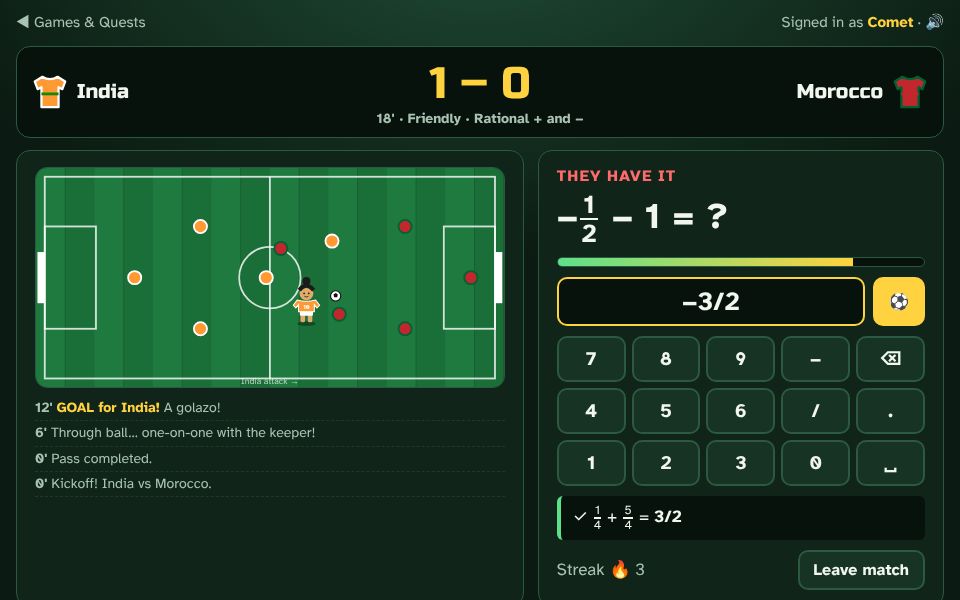
A soccer tournament where every pass, tackle, shot and save is a problem — and every miss shows the rule.
See the game →
LIVE PvP DUELS
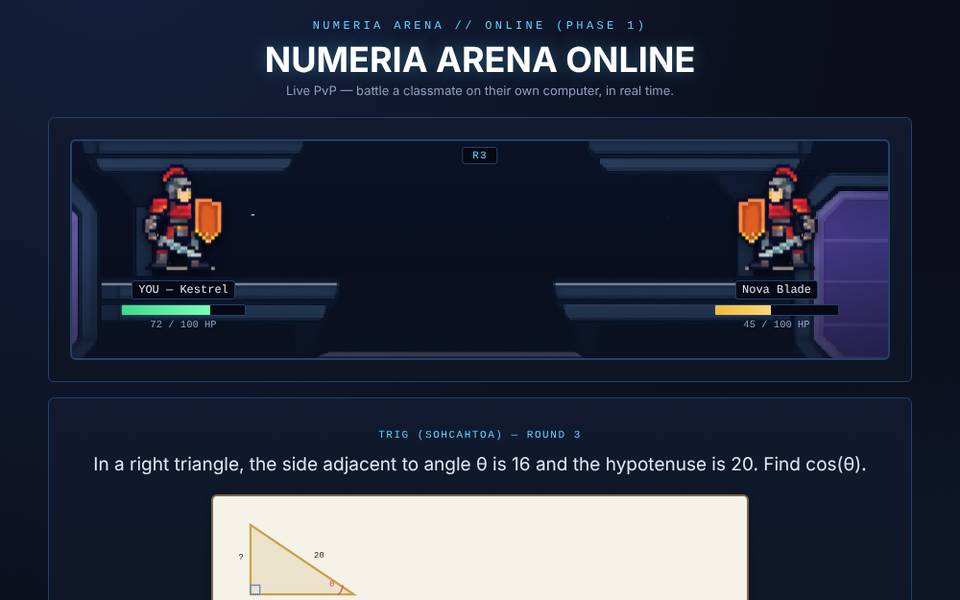
Two students battle with their characters in real time, solving problems on any topic you choose to land each attack.
See the game →
WHOLE-CLASS BOSS FIGHT
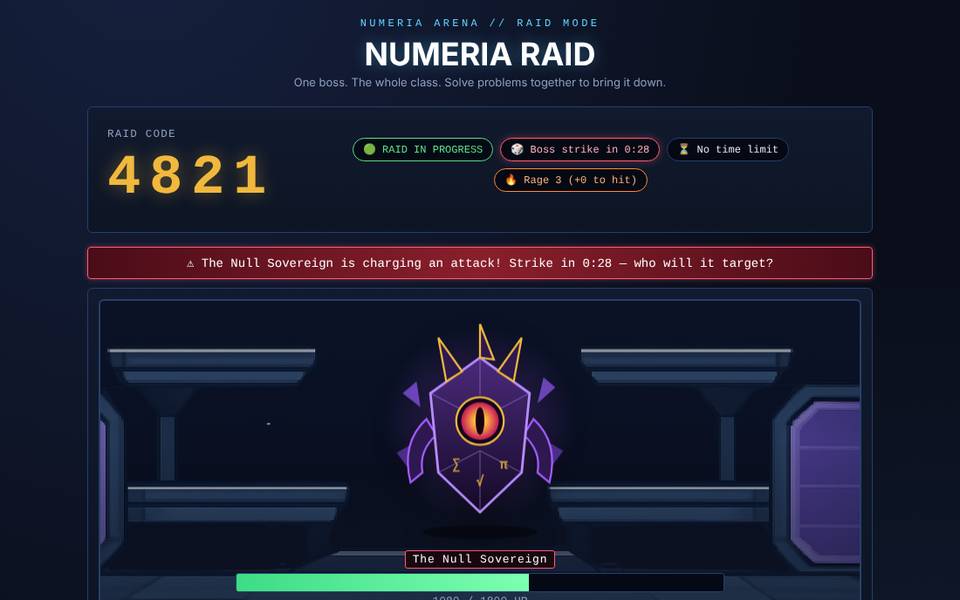
You run the raid on the projector. Students solve on their own devices, and every correct answer damages the boss.
See the game →
PYTHAGOREAN · DISTANCE · TRIG
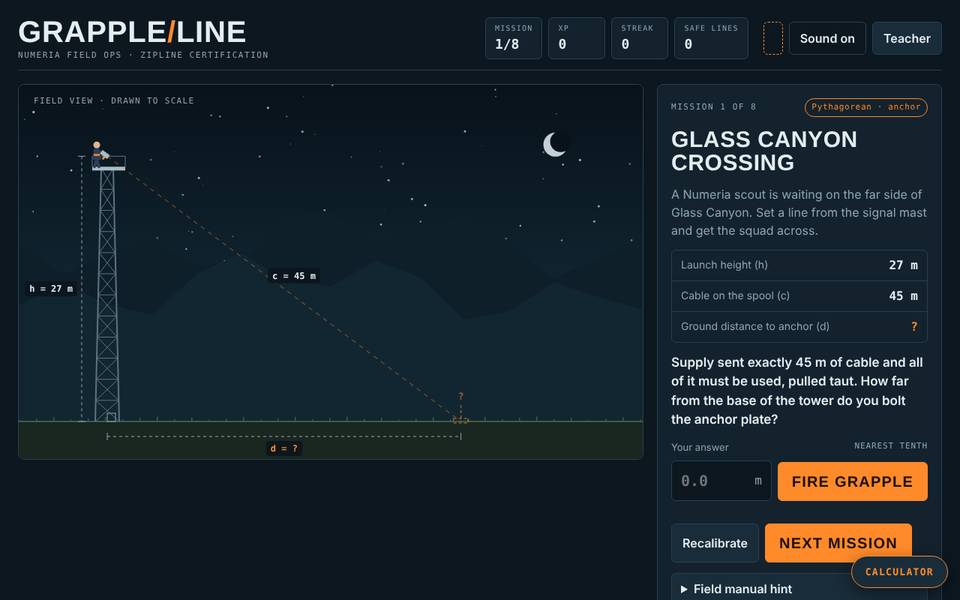
Students rig ziplines across canyons and towers — every tower, canyon and cable drawn to scale.
See the game →
DISTANCE FORMULA
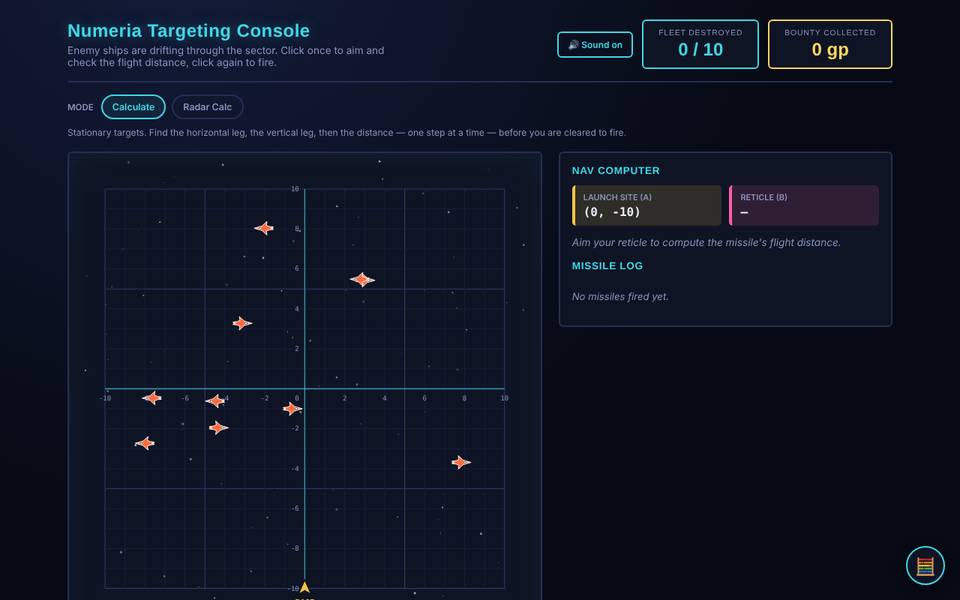
Enemy ships drift across a radar grid. Find the horizontal leg, the vertical leg, then the distance — then fire.
See the game →
SURFACE AREA
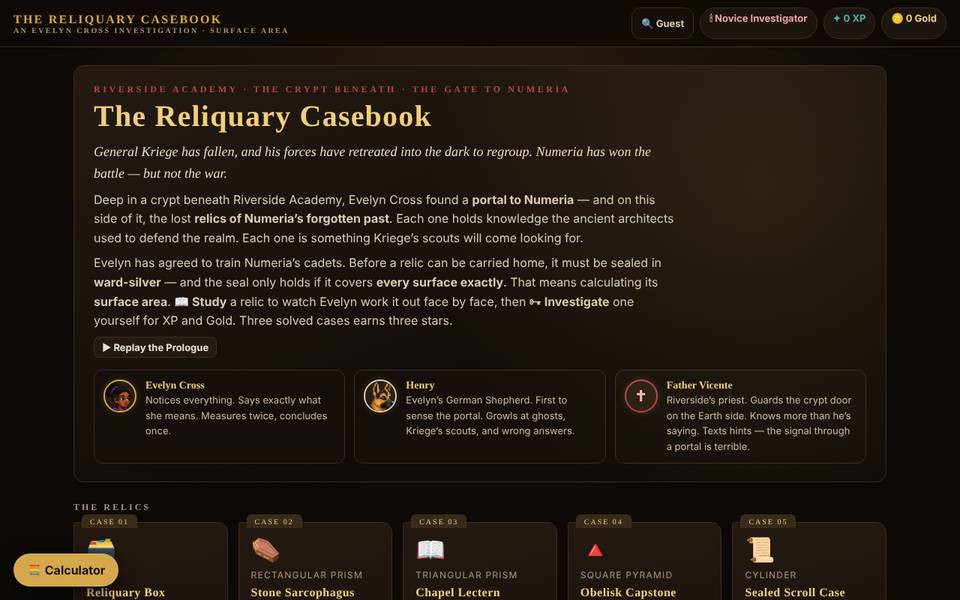
A mystery where each relic is sealed by finding its exact surface area, face by face.
See the game →
COORDINATE GEOMETRY
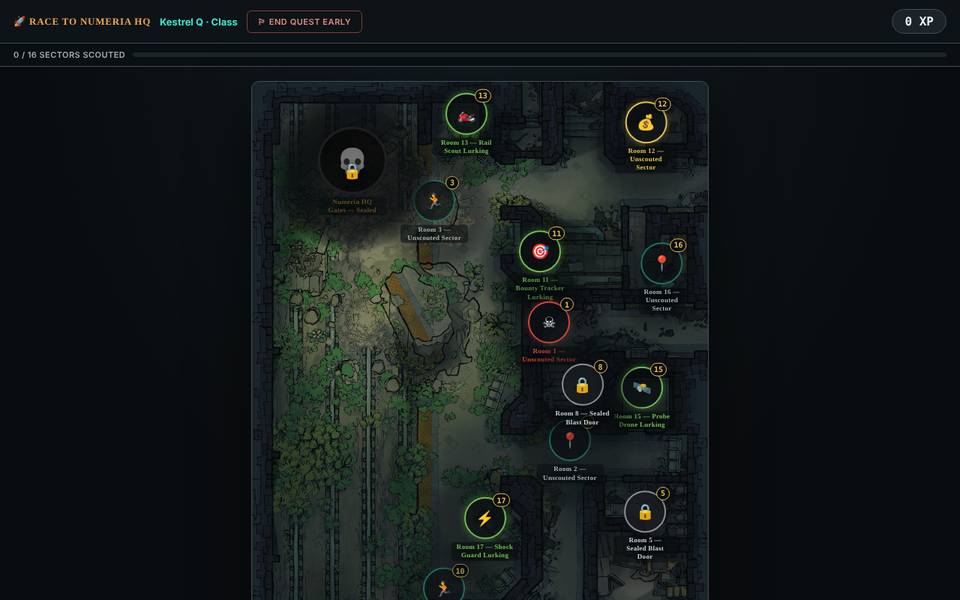
Scout a ruined town sector by sector. Locked doors and hidden caches open with correct answers.
See the game →
RATIONAL & IRRATIONAL NUMBERS
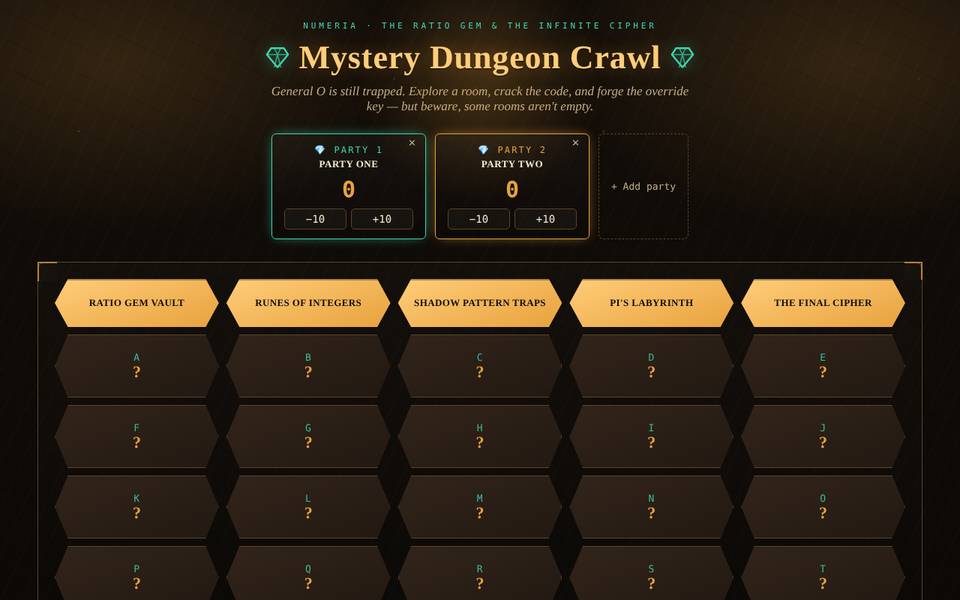
A team review game you run from the front of the room — pick rooms off the board, solve, earn points.
See the game →
TRANSFORMATIONS
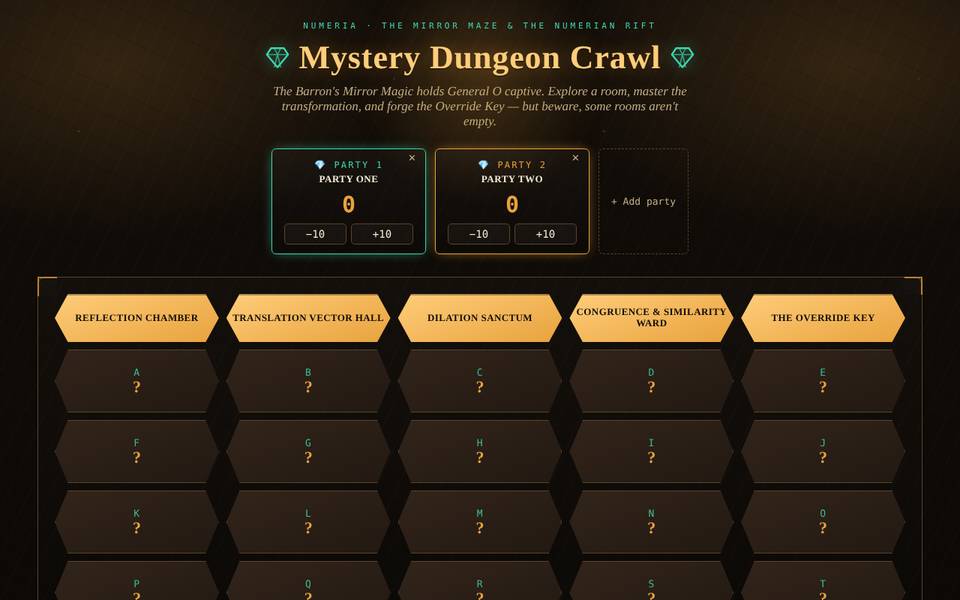
The team review game for Math 2: reflections, translations, dilations and congruence.
See the game →
VOLUME · SURFACE AREA · CUBE ROOTS
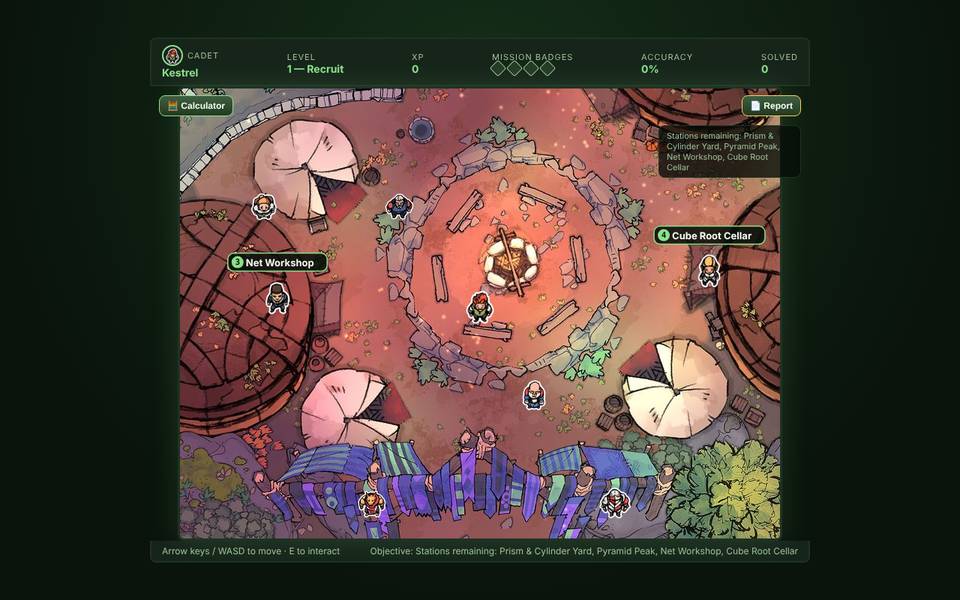
Walk a village map, visit building stations, and earn badges before the storm hits.
See the game →
RIGHT TRIANGLE TRIG
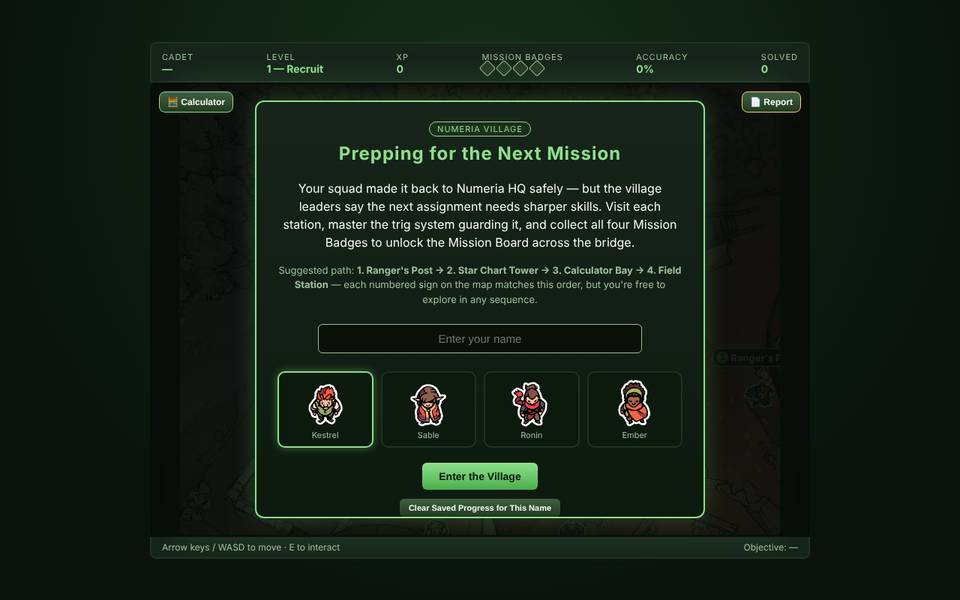
Train at four stations to master SOH-CAH-TOA and angle of elevation, then clear the Mission Board.
See the game →
PROPORTIONAL REASONING
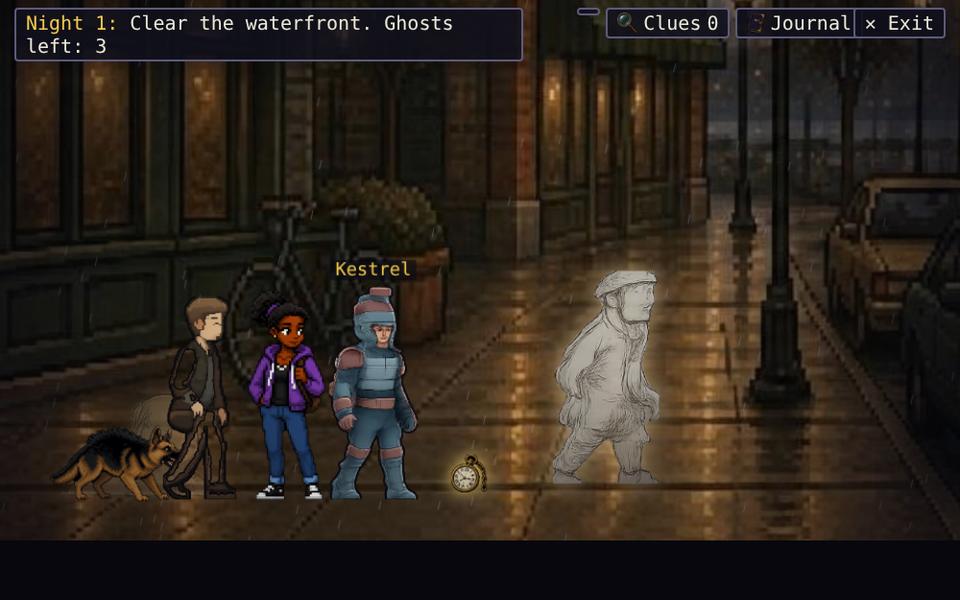
A story RPG: explore rainy Portland alongside Evelyn, Miles and Henry, with story labs like the Ghost Cart and the Shanghai Tunnels.
See the game →
PROPORTIONAL RELATIONSHIPS
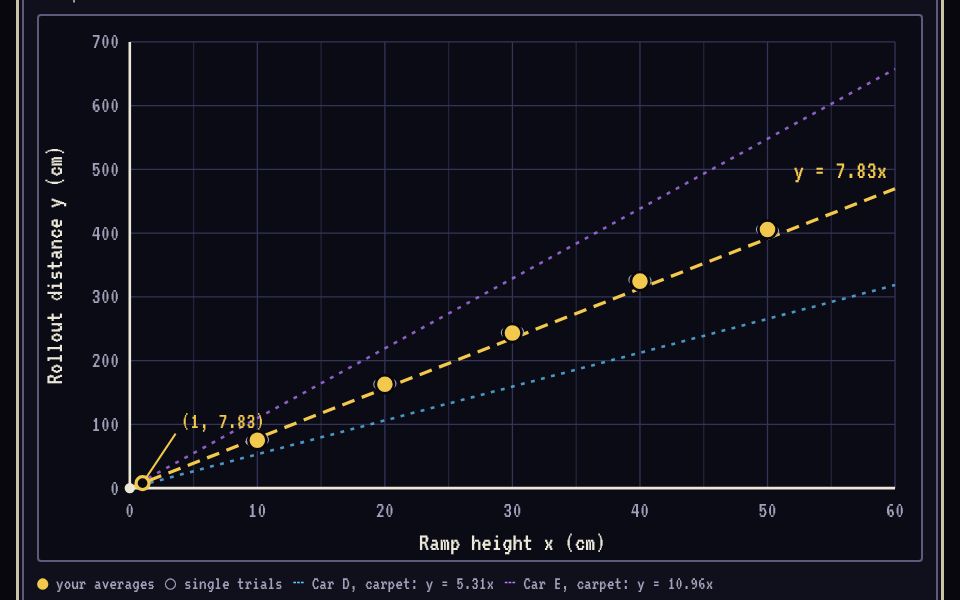
A ramp-and-car simulation: roll from five heights, find k, graph y = kx, then predict and test.
See the lab →
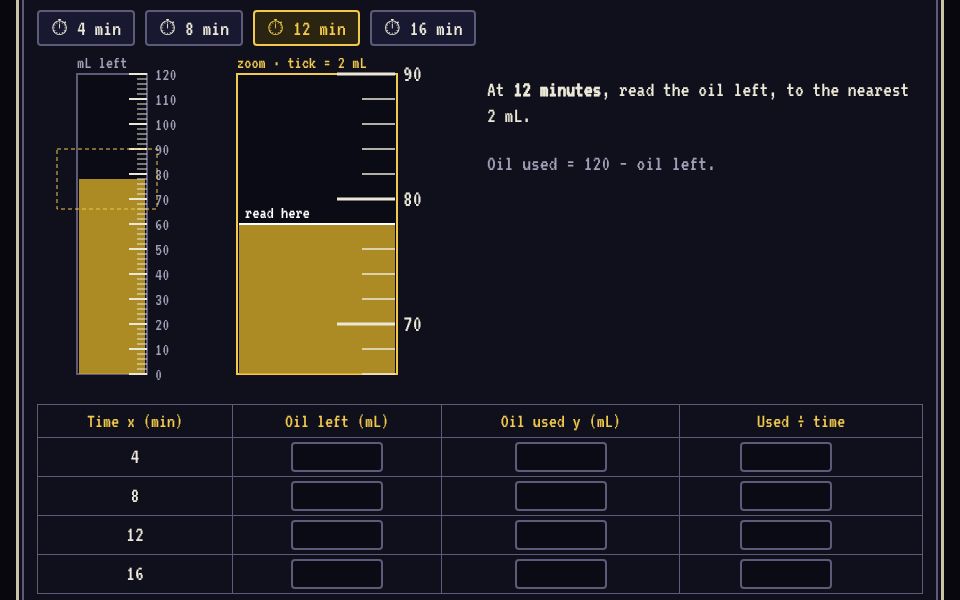
UNIT RATE · y = kx
Walking pace, a lantern's burn rate and a rising tide — then use k forward and backward to escape a dark tunnel.
See the lab →
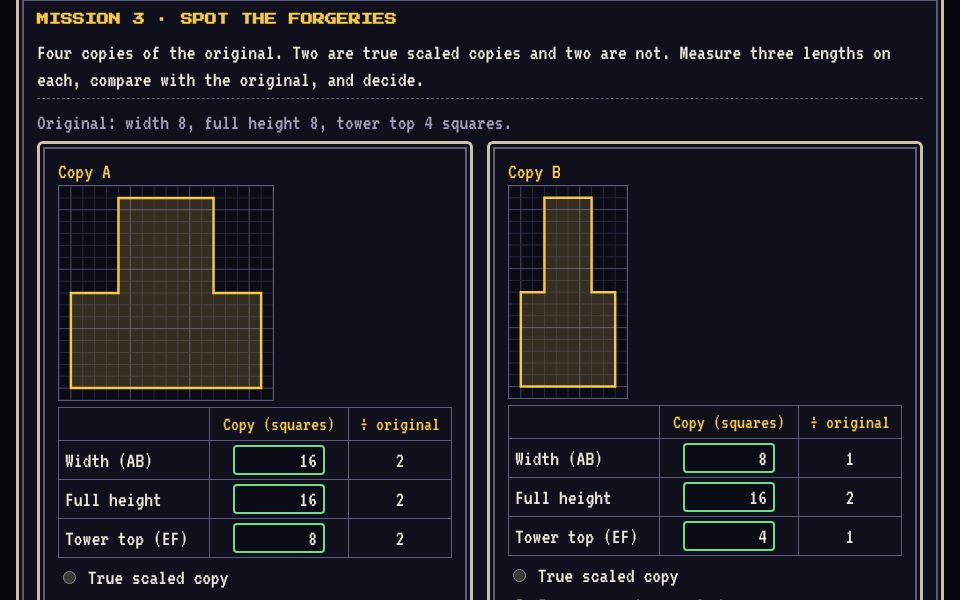
SCALE FACTOR
Measure copies, catch the forgeries, build a scaled copy and discover what happens to area.
See the lab →
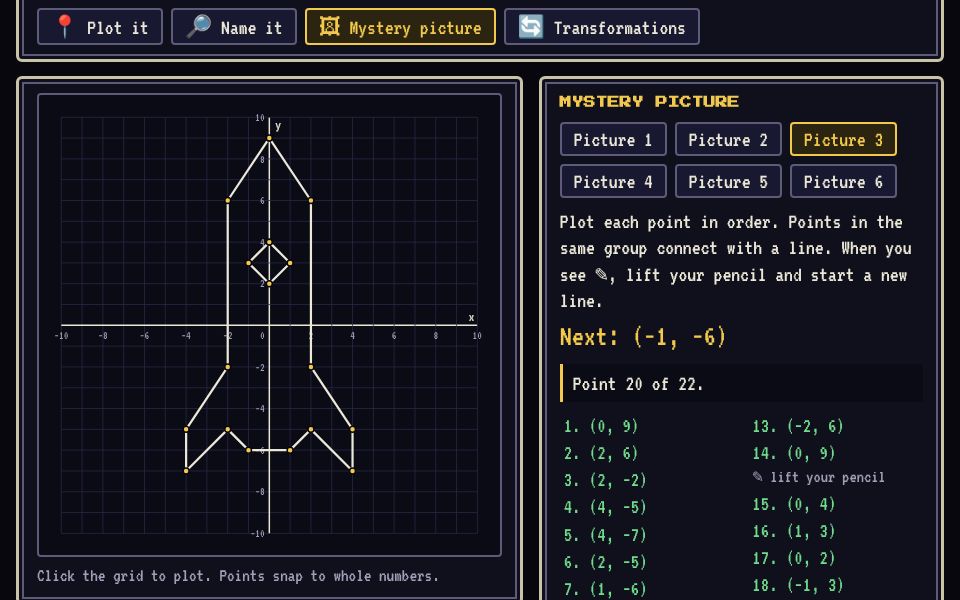
ORDERED PAIRS · TRANSFORMATIONS
Plot points, draw mystery pictures, and plot translations, reflections, rotations and dilations.
See the lab →
CONGRUENCE · SIMILARITY
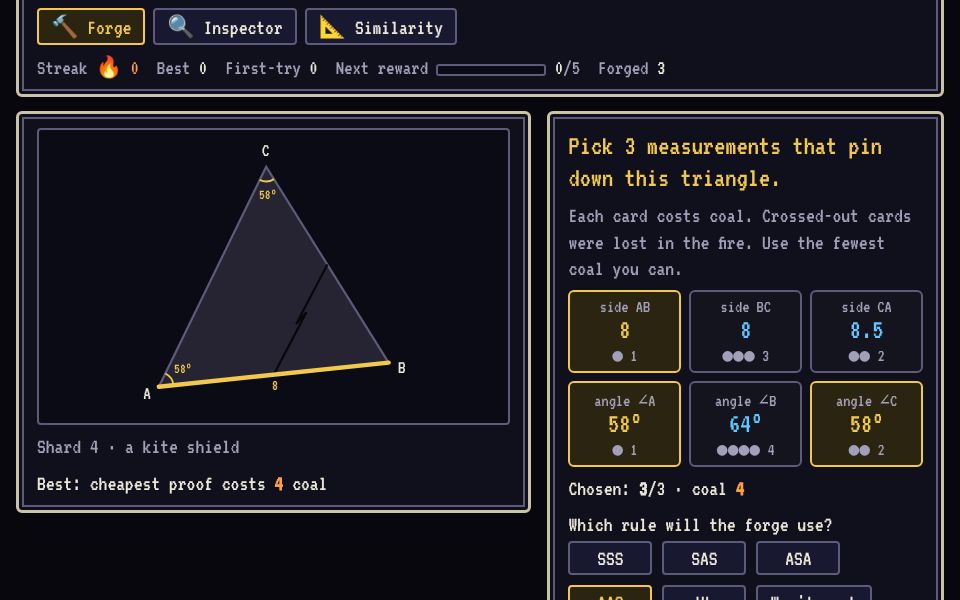
Forge shards by choosing the three measurements that pin a triangle down — and watch SSA and AAA fail.
See the lab →
PARALLEL LINES · TRANSVERSALS
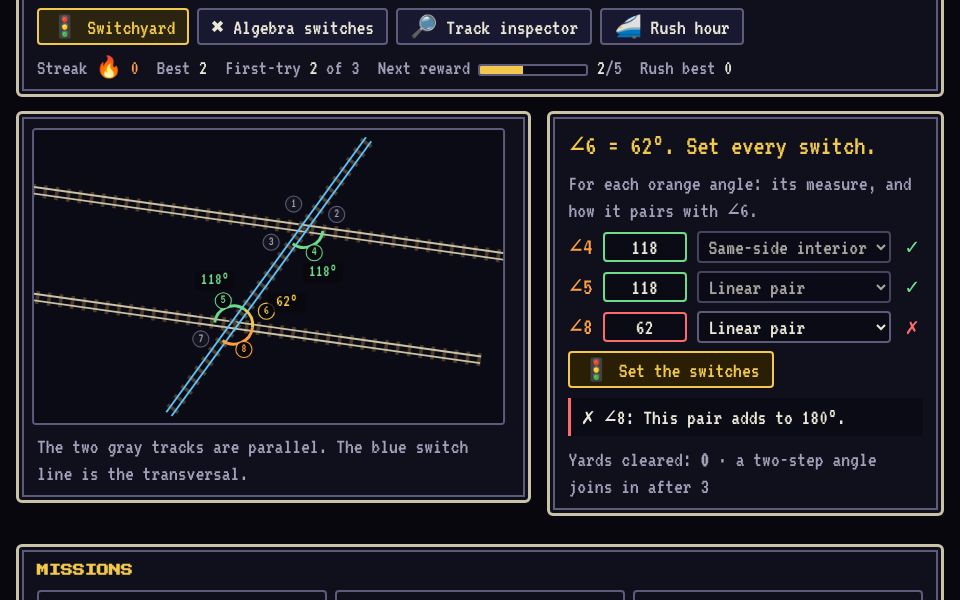
Set the switches: find every angle, name each pair, solve angle equations and race the clock in Rush Hour.
See the lab →
RATIOS
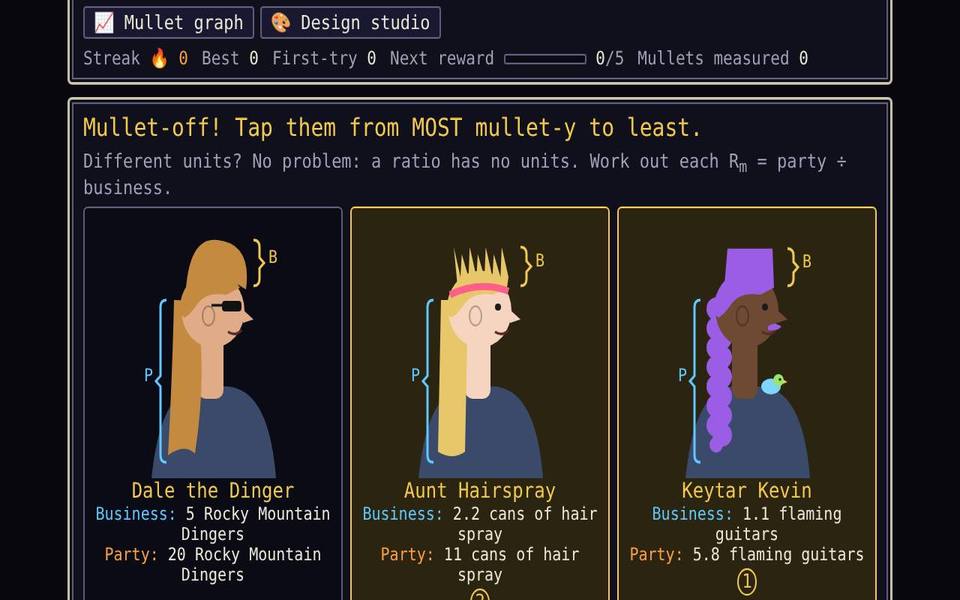
Business in front, party in the back: find the Mullet Ratio, judge mullet-offs and graph haircuts on y = kx.
See the lab →Numeria is the hub behind everything above — and I'm opening it to a small group of teachers. Your students get the games, the leaderboard, and the XP economy. You get a teacher portal that puts every setting in your hands.
Choose which games, modes, and rewards each class period can access — and rename games and tabs to fit your own theme.
Upload question banks for any subject by spreadsheet or CSV, or use the built-in content aligned to the NC Standard Course of Study.
XP and Gold from every game land on one class leaderboard. Rank by quarter or by year, and save each quarter's top 10 to a Hall of Fame.
Print a login card for each student with a code and a QR code. No student emails, no passwords, and only first names or nicknames.
30 days, full access.
Ready-to-use templates for teaching with LEGO bricks across math, ELA, science, and social studies — most work with or without a physical brick collection.
Repeated addition and equal groups, with lesson slides and a lab sheet.
Build scaled models while exploring ratios and proportions.
Create symmetrical brick patterns using a line of symmetry as a guide.
Earn brick types by solving problems, then build a fraction representation.
Base-plate or printable grid template for exploring factor pairs.
Draw group representations, reinforced with physical brick manipulation.
Visualize multiplication as bundled sets to reinforce repeated addition.
Count studs to measure perimeter, area, and volume — fully customizable.
Use a base plate as a graph foundation, colors as data categories.
Build a courtroom and act out a historical or fictional trial.
Read each labeled brick aloud before stacking — tallest correct tower wins.
Earn bricks by answering comprehension questions, then build the key scene.
Design a LEGO set representing a character, with an optional box-back design.
Predict the ending from context clues, then build and write about it.
Build a scene representing the predicted next story beat.
Create a film preview showing key moments and character development.
Depict exposition through resolution with written descriptions for each.
Demonstrate understanding of a single theme or several interwoven ones.
Engineer structures that withstand simulated earthquakes and wind.
Diorama of seed through flowering stage — template coming soon.
Build a taught simple machine and submit photo or video proof it works.
Build terrestrial, freshwater, marine, and one more ecosystem with explanations.
Color-coded brick models of cell structures, labeled and explained.
Build a 3D model of an assigned organ system with color-coded parts.
Design a wheelchair, catapult, bridge, boat, and a model town — judged live.
Design a space station that answers five guiding mission questions.
Design a sustainable city, weighing zoning and environmental impact — coming soon.
Research a historical period and build a physical LEGO timeline — coming soon.
Recreate an assigned historical event, with a presentation for peer Q&A.
Build two historical scenes and connect them to current events.
Design a LEGO set for a historical event instead of a fictional character.
Turn flat maps into physical elevation and landform models.
Build scenes comparing events and assess their toll on people and communities.

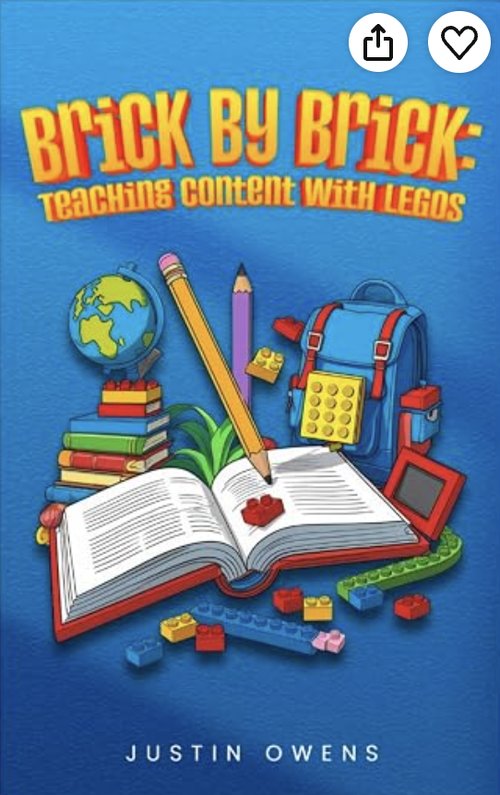
My book for educators on teaching with LEGOs — practical, classroom-tested ways to use building bricks to make abstract concepts concrete, without needing a dedicated STEM budget or a class set of anything fancy.
Get the Book